
Introduction – What Makes 3D Modeling Services So Frustrating Today?
For professionals in architecture, real estate, and design, ordering 3D modeling services can be an unpredictable and often frustrating experience. Delayed deliveries, unclear pricing, inconsistent quality, and unreliable communication plague even the most promising providers. As demand for architectural 3D modeling services grows, so does the need for platforms that offer reliability, scalability, and speed.
Archiviz.io was built to tackle these challenges head-on. By combining studio-level quality with freelancer-like flexibility, it aims to change how clients experience and benefit from 3D modeling services.
Archiviz.io – What it is all about?
- Architectural Renderings Online – Affordable, Fast & Scalable via Archiviz.io >>
- Top 10 Challenges Architectural Visualization Artists Face in 2025 >>
- Archiviz.io revolutionizing 3D Visualization industry! >>
- Archiviz.io: Revolutionizing construction 3d modeling for UK Projects >>
This article answers the following questions:
- What are the most common problems with 3D modeling services?
- Why do architectural 3D modeling services often fail to scale?
- How does Archiviz.io ensure transparent pricing in 3D modeling services?
- How can you avoid long delays when ordering 3D modeling services?
- How does Archiviz.io deliver consistent quality despite using multiple artists?
- What tools help improve communication in 3D modeling projects?
- How are 3D artists matched effectively to each project?
- Can 3D modeling services scale for large development agencies?
- What kind of results have real clients seen with Archiviz.io?
- Why is Archiviz.io a future-proof choice for architectural 3D modeling services?
The Most Common Problems in 3D Modeling Services – What Buyers Complain About
Lack of transparency, slow deliveries, and inconsistent quality
Ordering 3D modeling services can feel like a gamble. Many clients enter the process unsure of what they’ll receive, how much it will cost, or when it will be delivered. The most frequently cited complaints include:
- No clear pricing before placing an order
- Missed deadlines or prolonged turnaround times
- Visual quality varying drastically between projects
- Poor communication between the client and the 3D artist
- Limited ability to scale orders for larger projects
These issues are especially common in architectural 3D modeling services, where every day of delay or misalignment can affect development timelines and budgets.
For clients who require repeatable, scalable, and predictable results, traditional service providers often fall short. That’s where Archiviz.io sets itself apart—with defined processes, vetted artist pools, and transparent workflows.
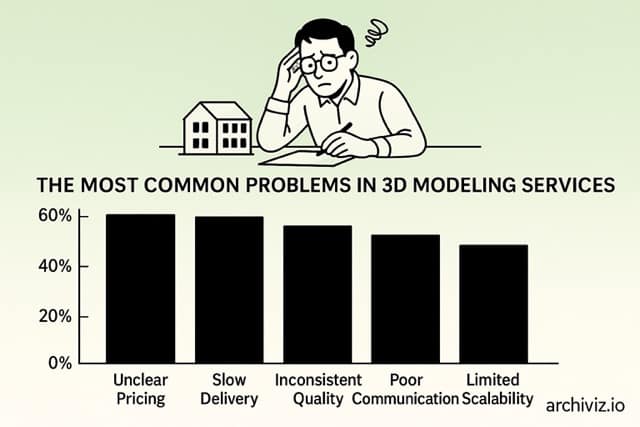
Bar graph of user complaints in 3D modeling
Interested in rendering and 3D visualization pricing?
- How Much Do 3d Renderings Cost? Key Pricing Factors >>
- 3D Rendering Pricing in 2025: What You Should Really Pay for a Render >>
Why 3D Modeling Services Often Fail to Scale in Architecture Projects
Scaling issues in architectural 3D modeling services
As architectural projects grow in complexity and volume, many traditional 3D modeling services struggle to keep up. The problem isn’t just about capacity—it’s about coordination, quality control, and workflow efficiency. When multiple models are needed across various property types or development phases, most service providers break down.
The core scaling issues in 3D modeling services typically include:
- Lack of standardized processes: Many providers rely on fragmented workflows that don’t support large-volume orders or iterative updates.
- No centralized project management tools: Clients are forced to manage communications and revisions manually across email threads and shared drives.
- Limited artist availability: When relying on a small freelancer pool or a local agency, there’s rarely enough capacity to handle multiple projects simultaneously.
- Unreliable timelines: As order volume increases, delivery delays become more frequent—especially when feedback loops are poorly managed.
These problems are particularly visible in architectural 3D modeling services where developers need dozens of variations for layouts, units, and phases—sometimes under strict marketing or investor deadlines.
How scalability impacts time, cost, and quality
The inability to scale doesn’t just slow things down—it leads to increased costs, uneven results, and frustrated clients. Without a robust infrastructure, the risk of quality inconsistency across deliverables rises sharply, especially when working with different artists or subcontractors.
This is where Archiviz.io introduces real value. The platform was built from the ground up to handle multiple simultaneous projects by:
- Providing a centralized production dashboard
- Assigning jobs dynamically based on artist availability and skill match
- Standardizing output formats and review processes
- Supporting repeatable, scalable ordering for agencies and developers
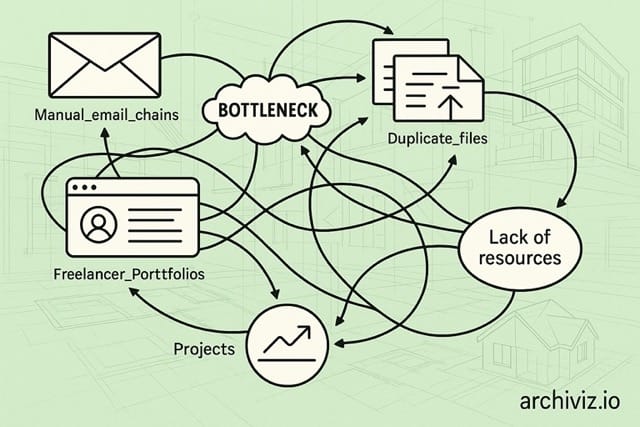
Workflow limitations in architectural 3D modeling services
Interested in best archiviz companies?
- Best Render Companies in the World – Ultimate Guide to Top 3D Visualization Firms >>
- Premium Architectural Visualization Services >>
- Top 10 3D Modeling Services in 2025 >>
- Studio 3D Animation: What Are The Top Studios In 2025? >>
- Top 3d Render Services: Stunning Visualizations >>
- Looking to order 3D visualizations from one of the most affordable providers in Scandinavia? Learn more at Visu24.com >>
Transparent Pricing in 3D Modeling Services – How Archiviz.io Ends the Guesswork
Why pricing in 3D modeling services is often unclear
A common frustration when ordering 3D modeling services is the lack of upfront, transparent pricing. Many service providers operate without clear price lists or rely on vague, case-by-case quotes. This unpredictability leads to:
- Wasted time during back-and-forth price negotiations
- Risk of hidden costs appearing mid-project
- Difficulty budgeting for larger or multi-phase architectural projects
- Lack of clarity on what’s included (number of revisions, deliverables, usage rights)
Architectural 3D modeling services, in particular, tend to vary in scope—from simple massing models to detailed, textured visualizations with annotations. When pricing structures aren’t standardized, clients are left guessing about both cost and outcome.
How Archiviz.io provides clarity and speed with instant quotes
Archiviz.io solves this by offering an online quote configurator that instantly shows pricing based on selected project parameters. Instead of long negotiations or inconsistent proposals, the platform delivers:
- Real-time pricing updates as clients adjust project details
- Clear inclusion breakdowns (e.g., base modeling, materials, revisions)
- Add-on pricing for extras like animations or multiple camera angles
- Transparent pricing ranges shown before any commitment
This structure makes it easy for developers, architects, and marketers to compare options, plan ahead, and place orders confidently—even for large or recurring projects.
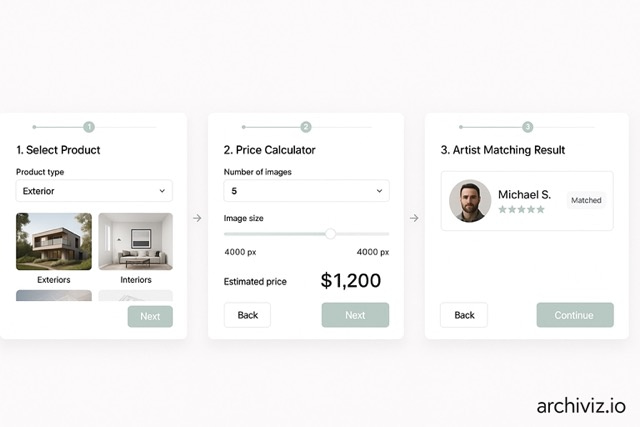
Price configurator screenshot
Are you interested in rendering? Read more:
- Expert Exterior Rendering Guide: How to Create Stunning 3D Facade Visuals >>
- Top Rendering Mistakes – How to Avoid Them? >>
- 20 Stunning Architectural Rendering Examples That Will Inspire You >>
- Expert Animation and Rendering: Pro Tips >>
- Architectural Rendering Styles: 8 Techniques You Can Use Immediately!>>
- Innovative 3d Renders Architecture Trends for 2025 >>
- 10 Essential 3D Visualisation Skills to Master in 2025 >>
Fast Turnaround in 3D Modeling Services – How Archiviz.io Eliminates Delays
Why 3D modeling services are often slow to deliver
Delays are one of the most frequent complaints in 3D modeling services, especially in time-sensitive architectural projects. When deadlines are tight and visualizations are needed for investor decks, client presentations, or marketing materials, waiting several weeks for delivery is not an option.
Several factors contribute to slow turnaround times in traditional 3D modeling workflows:
- Limited artist availability or overbooked studios
- Lack of defined production milestones
- Slow feedback loops and revision cycles
- Disorganized task management, especially with freelancers
For architectural 3D modeling services in particular, each delay compounds risk across design, approval, and construction timelines.
How Archiviz.io accelerates delivery without sacrificing quality
Archiviz.io solves the speed problem with a platform designed for structured, scalable production. The workflow is built around clear milestones, responsive collaboration, and pre-vetted artist availability, resulting in rapid execution across projects of all sizes.
Key features that boost delivery speed include:
- 3–5 business day turnaround times for typical static 3D modeling deliverables
- Built-in milestone tracking for draft, comment, and final stages
- Pre-scheduled artist allocation based on real-time availability
- Streamlined feedback system with image-based markup and notifications
Clients no longer need to follow up manually or chase updates—progress is visible through a centralized dashboard, with communication and approvals all managed in one place.
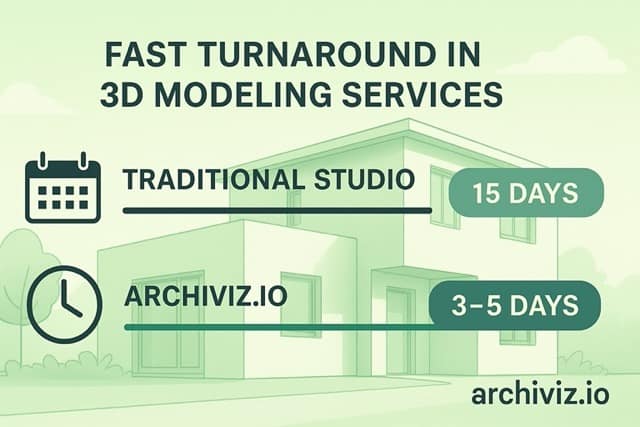
Timeline chart comparing delivery times
Interested in animations and cinemagraphs?
Consistent Quality in 3D Modeling Services – How Archiviz.io Solves the Skill Variability Problem
Inconsistent results in architectural 3D modeling services
One of the biggest risks in outsourcing 3D modeling services is inconsistent quality. Even when providers offer a portfolio of high-quality work, results can vary dramatically between projects. This issue becomes especially problematic in architectural 3D modeling services where visual precision and design intent are critical.
Common causes of quality inconsistency include:
- Working with freelancers of varying skill levels
- Lack of standardized modeling and rendering protocols
- Poor briefing processes or misinterpretation of client intent
- Overreliance on one artist, leading to quality drop-offs under pressure
For clients managing multiple visualizations—such as housing unit variants, layout options, or development phases—consistent visual style and technical accuracy are essential.
How Archiviz.io ensures visual consistency at scale
Archiviz.io addresses the quality problem by combining human curation with automated processes. The platform matches each project to the right artist based on technical skills, past performance, and preferred visual style. In addition, all artists work under shared guidelines and file standards.
Quality control features include:
- Vetted artist network with proven architectural visualization portfolios
- Style-matching algorithm that aligns artist style with project goals
- Standardized quality guidelines across formats, lighting, and material realism
- Optional art direction layer for premium-quality projects requiring extra oversight
This hybrid model guarantees that even large-volume 3D modeling services—such as residential portfolios or commercial building campaigns—maintain visual harmony and production-level consistency.
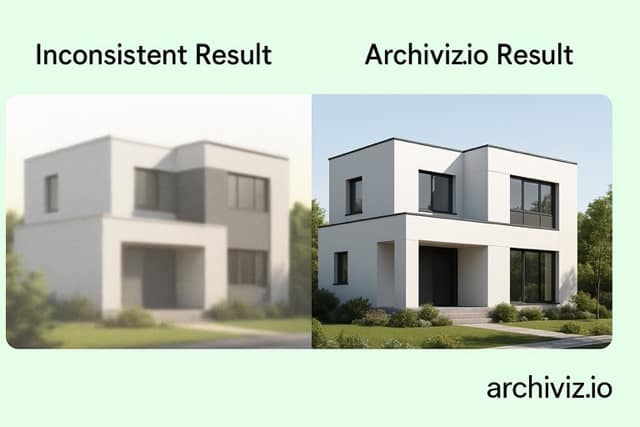
Comparison of high-quality and low-quality renderings
Archiviz ABC articles:
- 3D Modeling – Everything You Need to Know About 3D Modeling >>
- Guide on 3D Architectural Rendering >>
- Rendering Software – Complete Buyer’s Guide for Architects and Developers (2025) >>
Communication in 3D Modeling Services – How Archiviz.io Improves Collaboration
Why communication gaps hinder 3D modeling service outcomes
Effective communication is a critical factor in the success of any 3D modeling project. Yet, many architectural 3D modeling services still rely on fragmented tools and processes. Email chains, inconsistent feedback, and lack of clarity in briefs often lead to:
- Misaligned expectations between client and artist
- Time lost in clarification loops
- Increased number of revision rounds
- Frustration for both sides, especially under tight deadlines
Traditional workflows also lack visual feedback tools, making it harder to point out specific issues on render previews. This slows down the process and increases the chance of misinterpretation.
How Archiviz.io enables seamless communication between clients and artists
Archiviz.io eliminates these challenges by offering built-in tools designed specifically for 3D modeling collaboration. Everything from project instructions to revision comments is centralized and visually guided. The platform’s integrated system ensures all stakeholders remain aligned throughout production.
Key features that improve communication in 3D modeling services include:
- Structured project briefing interface to ensure clarity from the start
- Image-based commenting tools that allow clients to annotate directly on previews
- Centralized communication thread accessible by both client and assigned artist
- Real-time notifications for new messages, status changes, or uploaded drafts
These features allow architectural 3D modeling services to be managed like professional creative productions—with clarity, accountability, and efficiency at every step.
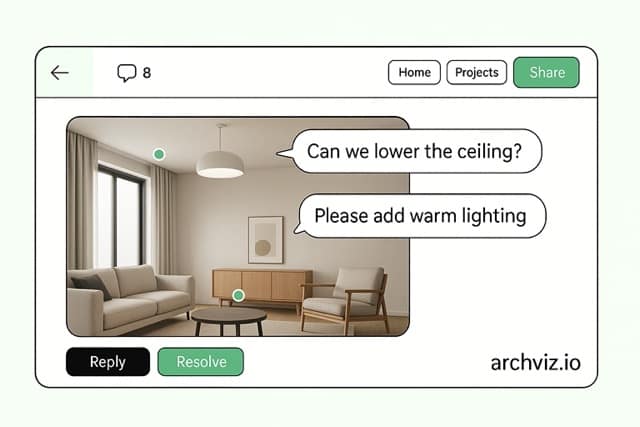
UI mockup of comment system
Interested in 3D services?
- What Is Virtual Tour – Everything You Need to Know for 2025 >>
- Stunning Interior Design Portfolio Examples >>
- Elevate UK Design with Architectural Visualization 3D >>
- Virtual Property Tours: Revolutionizing UK Real Estate >>
- Check Archiviz.io’s Renderings and 3D-Visualization services here! >>
Artist Matching in 3D Modeling Services – How Archiviz.io Uses AI to Assign the Right Talent
The challenge of matching the right 3D artist to each project
In many 3D modeling services, artist selection is a manual and often random process. Clients are either assigned a default freelancer or must search through portfolios with little guidance. This guesswork results in mismatches that can affect the project timeline, style consistency, and final quality—especially within architectural 3D modeling services where visual language and spatial understanding are critical.
Problems that arise from poor artist-project alignment include:
- Misaligned style between model output and client expectation
- Time wasted in revision loops to “fix” direction mismatches
- Slower deliveries due to artists learning project-specific standards on the fly
- Loss of client confidence and higher project abandonment risk
How Archiviz.io uses AI-driven artist matching to optimize results
Archiviz.io solves this problem with an AI-powered matching system that allocates the most suitable artist for each 3D modeling project. Instead of relying on luck or manual browsing, the platform leverages data on previous performance, availability, specializations, and visual style preferences to ensure a precise fit.
Key features of the artist allocation system include:
- Skill-based filtering to ensure technical capability for complex architectural models
- Visual style mapping to align output with brand, material realism, or desired aesthetic
- Real-time availability checking to prevent booking delays
- Performance-based tracking to prioritize artists with high ratings and fast turnaround
This intelligent matching process guarantees more efficient production, fewer rounds of revisions, and better results across all architectural 3D modeling services.
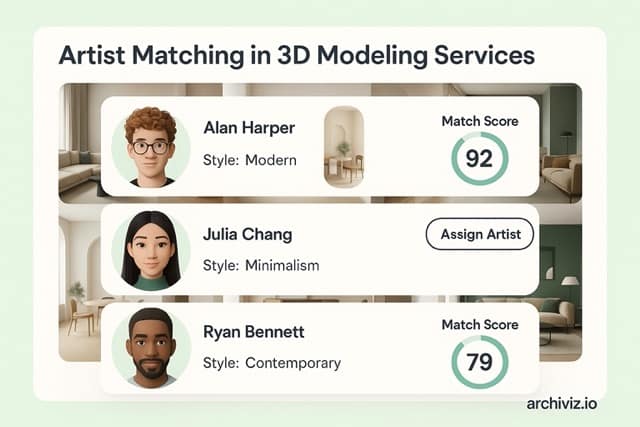
Dashboard mockup showing artist match suggestions
Interested in Drone Photography?
- Drone photography for real estate: Stunning Aerial Views >>
- Drone Photography UK – What It Costs in 2025 & How to Book Smarter >>
Scalable 3D Modeling Services – How Archiviz.io Supports Agencies and Developers
Why scalability is critical for architectural 3D modeling services
For real estate developers, construction firms, and marketing agencies, scalability is more than a nice-to-have—it’s essential. Architectural 3D modeling services often need to support dozens or even hundreds of visuals across multi-phase projects, unit variations, or repeated campaigns. Traditional studios and freelancers struggle to keep up without compromising quality, speed, or cost control.
Challenges with scaling 3D modeling services include:
- Limited artist bandwidth for handling multiple simultaneous models
- Disorganized asset management and project tracking
- Manual communication and feedback that becomes unmanageable at volume
- Inability to maintain consistent branding or style across outputs
Without a platform that supports structured volume production, large clients are forced to split projects across providers—leading to fragmented results and duplicated effort.
How Archiviz.io enables scalable production workflows
Archiviz.io was built with scalability at its core. Whether it’s a 200-unit residential portfolio or an international developer launching a series of buildings, the platform adapts to meet demand without losing efficiency or visual cohesion.
Scalability is achieved through:
- Multi-project dashboards that allow agencies to manage several orders at once
- Artist assignment automation based on workload and project type
- Reusable briefing templates to reduce onboarding time for new projects
- Optional white-label features for agencies reselling 3D modeling services under their own brand
This makes Archiviz.io a practical solution not just for one-off renders, but for entire portfolios that need streamlined production and professional-grade results—reliably and repeatedly.
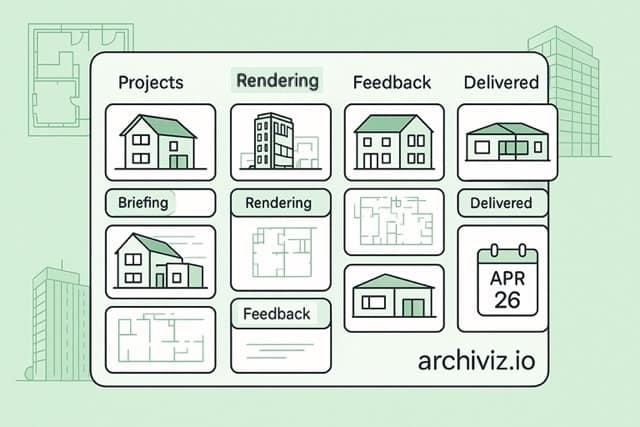
Dashboard with 10+ simultaneous projects
Read more why to buy 3D services:
Real-World Results from 3D Modeling Services – How Clients Save Time and Money with Archiviz.io
Why outcomes matter when choosing architectural 3D modeling services
In the crowded market of 3D modeling services, performance metrics often get buried beneath flashy portfolios and vague promises. For professionals working on tight budgets and timelines, the most important question is simple: Does it work?
Architectural 3D modeling services must not only look good—they must deliver measurable results:
- Reduced turnaround time from briefing to final delivery
- Decreased internal workload and coordination friction
- Fewer revisions due to better quality and alignment
- Significant savings compared to traditional studio costs
Archiviz.io has helped dozens of clients—from real estate agencies to architectural firms—achieve exactly these outcomes.
Key client outcomes from using Archiviz.io’s 3D modeling services
Case studies across different industries show consistent performance improvements when using Archiviz.io as the core production partner for 3D modeling services. Common benefits include:
- Time savings of 30–50% in project delivery due to automated artist matching and milestone workflows
- Cost savings of 20–40% compared to traditional studios, without compromising quality
- Quality improvements from consistent use of vetted artists and platform-wide standards
- Higher client satisfaction with visual outputs aligned to expectations from the start
For example, one Nordic housing developer replaced a fragmented workflow involving five freelancers with Archiviz.io and reduced production time by 40%, while gaining greater style consistency across units and marketing materials.
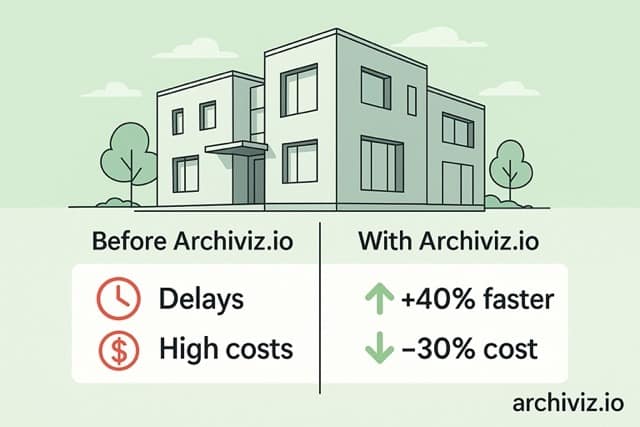
Case study visual of before/after time and budget
The Future of 3D Modeling Services – Why Archiviz.io Is Built for What’s Next
What the future demands from architectural 3D modeling services
As industries like real estate, architecture, and interior design become more digital, the expectations for 3D modeling services are rapidly evolving. It’s no longer enough to deliver good-looking visuals—services must now be fast, scalable, affordable, and seamlessly integrated into broader workflows such as BIM, real-time rendering, or AR/VR applications.
Emerging demands shaping the future of architectural 3D modeling services include:
- Faster production cycles to support agile design and iterative development
- Cross-platform integration with real-time tools and collaboration software
- On-demand scalability for global rollouts and multi-unit portfolios
- Data-driven optimization for artist selection, quote generation, and task tracking
- AI-assisted workflows for faster modeling, asset reuse, and precision
Without adapting to these trends, traditional service models risk becoming obsolete in the next 2–3 years.
How Archiviz.io is positioned to lead the next phase
Archiviz.io has been designed not just to solve today’s problems but to anticipate tomorrow’s needs. The platform is continuously evolving with new tools, automation layers, and AI-based enhancements aimed at redefining what 3D modeling services can deliver.
Key future-ready elements of Archiviz.io include:
- AI-based brief analysis and quote prediction to reduce planning time
- API and plugin integrations for syncing with external project management or BIM tools
- Talent marketplace expansion to scale globally with top-tier visualization artists
- 3D model reuse and templating system to speed up repeat orders
- Transparent roadmap that includes live collaboration, VR previews, and smart asset tagging
This strategic development approach makes Archiviz.io a long-term partner for agencies, developers, and designers looking for a future-proof way to handle architectural 3D modeling services at scale.

Archiviz.io logo overlaid on futuristic digital city
Ordering 3D Modeling Services – How to Get Started with Archiviz.io
A better way to start your 3D modeling project
Most clients looking for 3D modeling services face a familiar set of problems at the very beginning: unclear processes, manual quote requests, and uncertainty about who will handle their project. Archiviz.io eliminates this friction with a guided, self-serve system that allows clients to launch projects confidently, without back-and-forth emails or confusing onboarding.
Whether you need architectural 3D modeling services for a single building or a multi-site portfolio, Archiviz.io provides a seamless entry point with predictable outcomes and scalable production built in.
Step-by-step: How to order 3D modeling services on Archiviz.io
The platform is designed to streamline the ordering process while offering flexibility for different project types. Here’s how it works:
- Step 1: Configure your project
Use the intuitive online configurator to choose deliverables, modeling complexity, materials, and required formats. Pricing updates in real time. - Step 2: Submit your project brief
Upload drawings, references, and instructions. Use built-in templates for floorplans, exteriors, interiors, or furniture models. - Step 3: Receive artist match and timeline
Based on your inputs, the platform automatically matches your project with an available artist and provides a production schedule. - Step 4: Track production
Follow progress through a visual dashboard. Comment directly on drafts using the markup tool, and receive milestone updates. - Step 5: Final delivery
Download your finished 3D models or renders directly from the platform. All files remain accessible for future revisions or reuse.
This structure reduces the typical risks and confusion associated with outsourcing, replacing them with a user-controlled, transparent process optimized for architectural 3D modeling services.
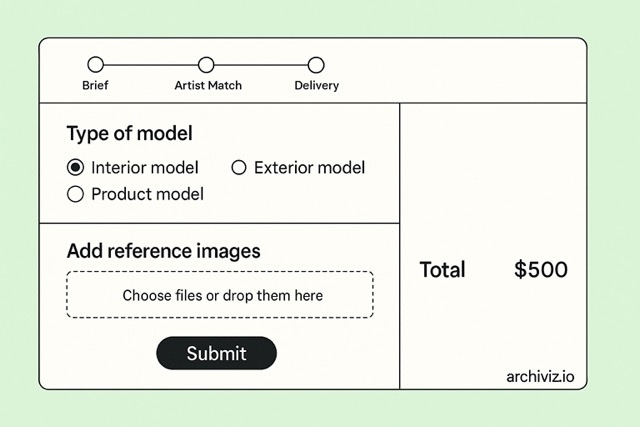
Screenshot of order configurator
Conclusion – A Smarter Way to Use 3D Modeling Services in 2025
For architects, developers, marketers, and designers, traditional 3D modeling services often come with a trade-off—between quality and speed, affordability and consistency, or simplicity and scale. Archiviz.io eliminates those trade-offs.
By combining automated processes with expert talent, the platform resolves the most common pain points in architectural 3D modeling services:
- Transparent, instant pricing
- Fast delivery within 3–5 business days
- Verified artists matched by style and availability
- Structured revision workflows and visual communication tools
- Scalable order handling for agencies and developers
Whether you’re working on a one-time render or managing a portfolio of projects, Archiviz.io offers a future-ready platform that simplifies production and improves outcomes—without compromising on quality or control.
Ready to experience a new standard in 3D modeling services?
Explore Archiviz.io to configure your next project in minutes and discover how seamless architectural 3D modeling can be.
Interested in 3D design?
- Master 3d Interior Design Rendering – Expert Tips >>
- Interested in Interior Design?? Read more: Master Interior Design Project Management >>
- Architecture Presentation Tips: Master Your Impact >>
- Top 10 Trends in 3D Renders Architecture for 2025: How Visualization Is Transforming Design >>
Interested in becoming an 3D artist?
 FI
FI  SV
SV  EN
EN  ET
ET  DA
DA  NB
NB  PL
PL  DE
DE